


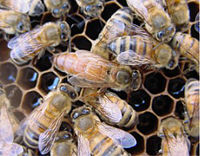
The term queen bee is typically used to refer to an adult, mated female that lives in a honey bee colony or hive; she is usually the mother of most, if not all, the bees in the hive.[1] The queens are developed from larvae selected by worker bees and specially fed in order to become sexually mature. There is normally only one adult, mated queen in a hive.
The term "queen bee" can be more generally applied to any dominant reproductive female in a colony of a eusocial bee species other than honey bees.
When conditions are favorable for swarming, the queen will start laying eggs in queen cups. A virgin queen will develop from a fertilized egg. The young queen larva develops differently because it is more heavily fed royal jelly, a protein-rich secretion from glands on the heads of young workers. If not for being heavily fed royal jelly, the queen larva would have developed into a regular worker bee. All honey bee larvae are fed some royal jelly for the first few days after hatching but only queen larvae are fed on it exclusively. As a result of the difference in diet, the queen will develop into a sexually mature female, unlike the worker bees.
Queens are raised in specially constructed queen cells. The fully constructed queen cells have a peanut-like shape and texture. Queen cells start out as queen cups. Queen cups are larger than the cells of normal brood comb and are oriented vertically instead of horizontally. Worker bees will only further build up the queen cup once the queen has laid an egg in a queen cup. In general, the old queen starts laying eggs into queen cups when conditions are right for swarming or supersedure. Swarm cells hang from the bottom of a frame while supersedure queens or emergency queens are generally raised in cells built out from the face of a frame.
As the young queen larva pupates with her head down, the workers cap the queen cell with beeswax. When ready to emerge, the virgin queen will chew a circular cut around the cap of her cell. Often the cap swings open when most of the cut is made, so as to appear like a hinged lid.
During swarming season, the old queen will likely leave with the prime swarm before the first virgin queen emerges from a queen cell
Virgin queen bee
| Metamorphosis of the queen bee | |
|---|---|
| Egg | hatches on Day 3 |
| Larva (several moltings) | Day 3 to Day 8½ |
| Queen cell capped | ~ Day 7½ |
| Pupa | ~ Day 8 until emergence |
| Emergence | ~Day 15½ - Day 17 |
| Nuptial Flight(s) | ~Day 20 - 24 |
| Egg Laying | ~Day 23 and up |
A virgin queen is a queen bee that has not mated with a drone. Virgins are intermediate in size between workers and mated, laying queens, and are much more active than the latter. They are hard to spot while inspecting a frame, because they run across the comb, climbing over worker bees if necessary, and may even take flight if sufficiently disturbed. Virgin queens can often be found clinging to the walls or corners of a hive during inspections.
Virgin queens appear to have little queen pheromone and often do not appear to be recognized as queens by the workers. A virgin queen in her first few hours after emergence can be placed into the entrance of any queenless hive or nuc and acceptance is usually very good, whereas a mated queen is usually recognized as a stranger and runs a high risk of being killed by the older workers.
When a young virgin queen emerges from a queen cell, she will generally seek out virgin queen rivals and attempt to kill them. Virgin queens will quickly find and kill (by stinging) any other emerged virgin queen (or be dispatched themselves), as well as any unemerged queens. Queen cells that are opened on the side indicate that a virgin queen was likely killed by a rival virgin queen. When a colony remains in swarm mode after the prime swarm has left, the workers may prevent virgins from fighting and one or several virgins may go with after-swarms. Other virgins may stay behind with the remnant of the hive. As many as 21 virgin queens have been counted in a single large swarm. When the after-swarm settles into a new home, the virgins will then resume normal behavior and fight to the death until only one remains. If the prime swarm has a virgin queen and the old queen, the old queen will usually be allowed to live. The old queen continues laying. Within a couple of weeks she will die a natural death and the former virgin, now mated, will take her place.
Unlike the worker bees, the queen's stinger is not barbed and is able to sting repeatedly without dying.


